 English
  Français
  Italiano


- IDEAS AND advices -
KITCHEN HABITAT
A JOURNEY THROUGH ISLANDS AND PENINSULAS, BEAUTIFUL AND FUNCTIONAL
Let’s talk about the heart of the home—the space devoted to food and sharing—and explore two of the most popular and sought-after layouts: kitchens with a peninsula or with a standalone island. The latter is a striking design choice that requires generous space to be fully enjoyed. It creates a fluid environment and, when the cooktop is placed on the island, it allows you to work while facing the surrounding space.
Suitable even for more compact spaces, the peninsula is also a functional element that connects the kitchen to the living area. It can serve as a work surface and accommodate either the sink or cooktop. As for the rest of the kitchen, tall units with fridge and oven often double as pantry storage, and can be paired with base cabinets, with or without wall units.
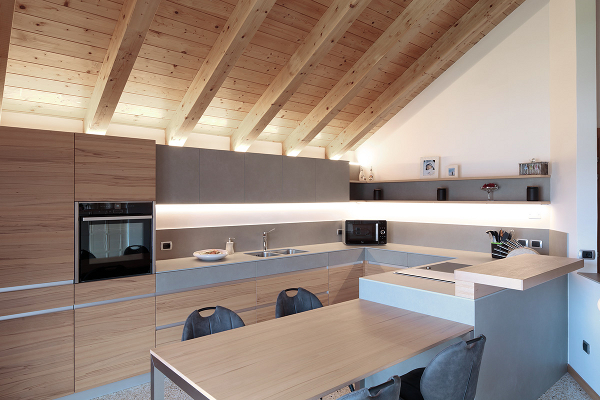
The layout of kitchen furniture defines not just the aesthetics, but also how the space is experienced day to day, shaping habits and routines. That’s why the kitchen needs to be well-dimensioned and planned around essential elements—those features that ensure we never tire of cooking, chatting, and spending time in the space. And above all, those that keep us from saying: “I don’t have enough space in the kitchen.”
Here are the key aspects to consider for good kitchen planning:
- Number of people living in the home and how often guests are present
- Storage needs for dishes and kitchenware
- Room dimensions and whether there's a separate dining area
- Intended use: daily or occasional meal preparation and dining

There’s also a general rule to follow: arrange the zones in this sequence whenever possible—storage (pantry, fridge), washing (sink, dishwasher), and cooking (cooktop)—separating them with worktops for optimal flow.
Here are 5 essential dimensions to keep in mind:
- In front of base cabinets and tall units, account for the space needed to open drawers and doors
- Leave at least 1 meter of free space in front of the dishwasher for loading and unloading
- The distance between work surfaces and a peninsula/island should be at least 1–1.2 meters, to allow space for a person to pass (shoulder width is typically 55–60 cm) and for doors or drawers to open
- Islands and peninsulas can feature one side as a worktop and the other as a snack counter with stools—perfect for a quick meal or breakfast. The overhang should be at least 30 cm to sit comfortably
- Keep passageways to windows, terraces, and interior doors clear and unobstructed
